 Slovenčina
  English
 Protecting identity, dignity, and peace in the South Caucasus through faith and dialogue.
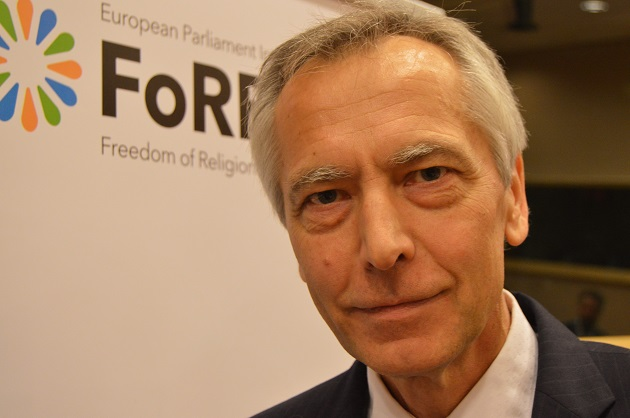
At a time of rising polarization and growing constraints on fundamental freedoms, Jan Figel reflects on the importance of interfaith dialogue and the protection of freedom of religion or belief.
Considering your experience as the EU Special Envoy for Freedom of Religion or Belief, how do you assess the role of the Catholicos of all Armenians in preserving the spiritual values and national identity of the Armenian people?
First of all, it is the Armenian Apostolic Holy Church which deserves respect and gratitude for the 17 centuries old work, struggle and sacrifices to defend faith, identity and even mere existence of Armenian nation in the long history full of great periods of development in South Caucasus, but also in times of conflicts, persecution and even genocide. Government´s attacks on its Supreme Representative is attack on the Head and autonomy of the Church. Voice of the head should be heard and dialogue is the way how to proceed. Free Church in free state working for justice, human dignity and common good of all citizens – it was a dream and objective of many faithful people and freedom fighters under Soviet oppression and Church persecution. After 1991 and dissolution of the USSR the new democratic Constitution and independent Armenia have been built. Constructive role of the AAHC led by the Catholicos, currently His Holiness Karekin II., is part of this shared responsibility and achievement.
In your opinion, how can the Armenian Apostolic Church and its spiritual leadership contribute to peace and dialogue in the South Caucasus region?
Peace is the key value for human existence and sustainable development. It stems not from papers and speeches, but principally from hearts of people. Role of Church here is irreplaceable: peace will not be born and spread by politicians, media and parties. They play important role, and can help. But peace is fruit of brotherly conviction and mentality of togetherness, love towards God and neighbor. From such culture of human dignity, a true interest, dialogue and compassion are born. Church helps to nurture this ethics based on “imago Dei” – image of God being recognized and respected in every human being. Truly Christian nations and communities in history were peaceful communities, changing their times and the world by power of example, dialogue and inspiration, not by rule of power or conquest. This is a historical lesson and contribution of Armenians and their Christian faith at home and in diaspora, in the world. Of course, there were some rulers abusing faith for religious conflicts.
What are the main challenges religious leaders face today in protecting the rights of believers and freedom of conscience?
Religious and faith communities are under various forms of attacks today. According the renowned Pew Research Center in Washington DC, almost four out of five people today live in countries with high or very high obstacles to freedom of religion. And this ratio is growing. Religion is part of mankind from the beginning of human history. Today over 84% of global population claim religious affiliation. Therefore, religious freedom, worship and identity concern the overwhelming majority of the world population. Challenges today are created by state (governments) or non-state actors (e.g. terrorist groups) or by society in general. These oppressive forms include social intolerance, discrimination, persecution and, regrettably, still genocides. Nine out of ten genocides in history have been based on religious identity. Therefore, respect to religious freedom in practice could eliminate most of genocides as repetitive failures of humanity, as a crime of crimes. According to serious reports (ACN, Open Doors, UK FCO Truro Report, …) 250 – 300 million of Christians worldwide are persecuted. It represents the biggest number of the persecuted adherents out of all religious denominations and the most scandalous violation of human rights in our era.
In your experience, have you encountered situations where religious leaders remained silent in the face of human rights violations? How do you assess such situations?
Silence in presence of grave injustice or crime is either human weakness or collaboration. Not all leaders are brave and courageous enough. Some may seek discreet form of protest or help by other, less visible means. It is also true that violators and abusers of power often intentionally divide clergy and the Church. We remember it well from the communist era when in my former country – Czechoslovakia – some pro-regime structures of clergy have been organized and supported by the state power. Ordinary people and faithful priests and bishops used to work underground, in parallel structures. Unity of Church – leaders and lay people – in defense of its autonomy and integrity is always very important.
Generally, evil in society is very successful when it has broadly spread allies. Three siblings – allies of evil – are very influential: indifference, ignorance and fear. They are impactful, if we do not care about problems in society and suffering of others, if we do not know, nor understand what is going on around us, and when we are afraid to say or to do something in defense of truth and justice. Therefore, we all – especially leaders – need to stay engaged, educated and courageous to stand up for those who are voiceless or defenseless.

Currently, there is tension in Armenia between Prime Minister Nikol Pashinyan and the Catholicos of all Armenians. How do you assess this situation and its potential implications for democracy, social unity, and religious freedom in the country?
Together with many likeminded people in the world, I am worried about this situation. Democracy without true, fundamental values tends to become autocracy or anarchy. Values, fundamental human rights and rules for good governance of Armenia are enshrined in and guaranteed by the Constitution of Armenia. Regrettably, since October 2025 provisions on religious freedom, Church – State separation and respect to Church autonomy are blatantly and growingly violated. Imprisonment of Church archbishops, bishops, clergy and lay people on false, fabricated accusations represent abuse of criminal law and misuse of state power against the Church and citizens. Armenia violates its commitment towards the UDHR Declaration and ICPPR Covenant as a UNO member, ECHR Convention as a Council of Europe member state, OSCE norms as a participating state and the EU primary law as a candidate country. Those facts are direct attacks and ongoing abuses of democratic power and violations of the rule of law. They destroy social cohesion and damage civic unity of Armenians.
Do you believe that religious leaders, including the Catholicos of all Armenians, are today using their influence sufficiently to prevent conflicts and political radicalization?
Democracy is in hands of people. Church is not linked or dependent on a form of state organization or power. But Church respects secular character of State. True, fair secularity leads to plurality in society. It is a blessing for religious freedom.
Secularism as ideology is detrimental for churches and religious communities, because it replaces freedom and plurality by a state ideology. We should remember it well from the Soviet times. Bolshevism, communism, atheism represented oppressive ideologies against human faith, dignity and freedom.
Religious leaders must work tirelessly for the truth about God, man and creation. Fruit of this truth and core message of Christianity is love. This should be visible from life, words and examples of those who are leaders in the name of Jesus Christ. I encourage them to lead, live and love like Jesus. There is nothing more important and influential they can offer individually, in community and institutionally.
In your view, what role can European institutions play in supporting interfaith dialogue and freedom of religion in the Eastern Partnership countries?
European institutions must care more for religious freedom inside and outside the EU. Because freedom of thought, conscience and religion is a litmus test of all human rights, crucial for believers and non-believers as well. If this fundamental and central freedom is violated then other ones are on the same path: freedom of opinion, expression, media, association, assembly… Freedom is linked to responsibility. They are two sides of the same coin. Therefore, religious social responsibility and inter-religious dialogue must be nurtured. But not dialogue for dialogue, but for joint effort to build justice, common good and dignified, peaceful life in Armenia and the whole region. Building Europe means building peace, as the European Founding Fathers used to express.
European Commission should nominate missing FoRB Special Envoy as soon as possible, and European Parliament should offer real political support to the principles and practices that gradually build united Europe based on common values. In the EU people in general and tax payers in particular expect that financial solidarity and cooperation projects in the framework of Eastern Partnership will strictly follow important and shared objectives. And instead of any tolerance of corruption or abusive practices of state power the EU institutions must fight against these detrimental phenomena.
February 11, 2026
Podobné články
 JAPAN: The Dissolution of the Family Federation is “Arbitrary”
 Why Japan Should Guarantee Religious Liberty to the Unification Church/Family Federation
 Persecution of Religious Minorities in the Middle East urges EU to act
 Figel’: “Action for Religious Freedom is a Moral Obligation”
 “Action for Religious Freedom is a Moral Obligation”
 PAKISTAN: Jan Figel’s views on religious freedom