 Slovenčina
 English
28/10/2026
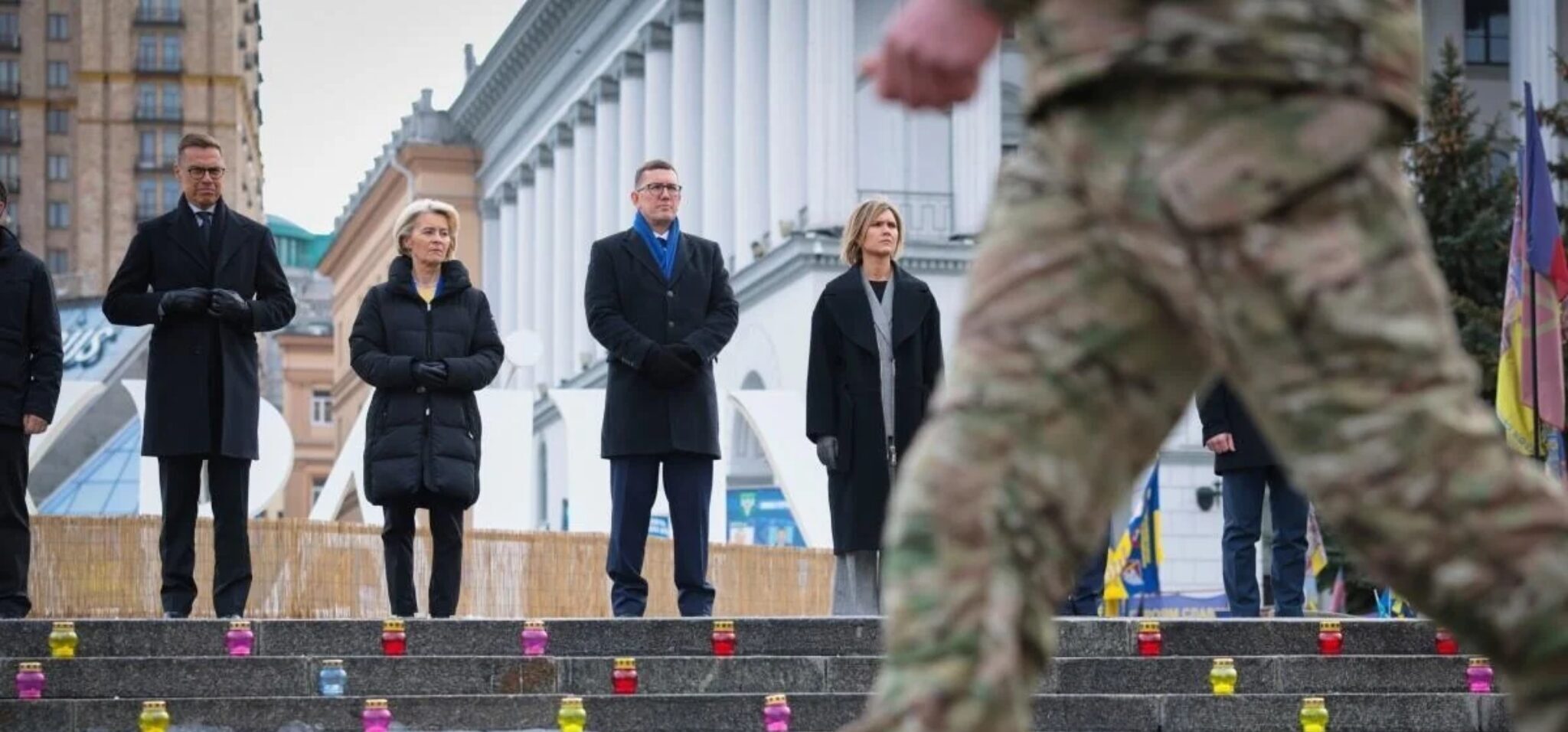
Peace is not simply one issue among others, but a prerequisite for the universal common good and a test of the moral maturity of peoples, especially of those who bear responsibility for governing.” (Pope Leo XIV)
Since 2014, a Cold War has returned to Euro-Atlantic area, invoked by internal conflict in Ukraine and Russian annexation of Crimea. Germany and France as guarantors of the 2015 Minsk Agreement did not guarantee its implementation. Ukraine could have remained whole, free, and democratic multi-ethnic state. Following the invasion by the Russian armed forces in 2022, the long and bloody interstate war started.
The European Union has failed to prevent or halt this conflict. It is as if there no longer are true successors to Schuman, Adenauer, De Gasperi, and Monnet, embodying their political vision, attitudes and actions. Similarly, one may critically ask what the OSCE, signatory of Minsk I Agreement (2014), has actually done for collective security and cooperation over the last dozen years.
Over 20 EU sanction packages against Russia and massive rearmament have not brought peace any closer. The consequences of war in Ukraine—like in the Middle East and Iran—are manifold and painful for ordinary citizens. Euro-Atlantic region faces high energy prices, significant inflation, public finance deficits, national debt, economic stagnation, bankruptcies, and rising migration. Political shifts in Germany, along with social unrest and violence in France call for a fundamental change in course.
The war in Ukraine continues to escalate. Things could still get even worse. Two world wars originated on the Old Continent. History does not repeat itself, but it may rhyme. It is essential to preserve the memory of nations for fostering a sense of belonging and shared responsibility. Because peace, stability, security, and prosperity are inextricably linked.
Yet, the way out of the quagmire of war lies in the hands of the East and the West. The West emerged victorious in the first Cold War, but it failed to secure peace. We failed to create a unified Europe—a single community encompassing all nations. Changes occurred solely through the expansion of one pole, disregarding deep-seated historical, cultural, and geopolitical realities. We have transitioned from a state of bipolarity to unipolarity. Now, as Pax Americana draws to a close—driven by American politics itself, the rising influence of China and the formation of the BRICS, a multipolar order is emerging.
The principles employed by R. Schuman and G. Marshall in their plans for peaceful cooperation and post-war reconstruction of Europe remain relevant. They should be applied again, serving as a foundation for a genuine and sustainable peace. A dignified peace agreement is urgently needed and possible. It is essential for the nations that have long suffered from the consequences of war.
Many observers view the confrontation between two nuclear powers through conflict in Ukraine as a proxy war. Consequently, the United States and the Russian Federation could today serve as the primary, foundational protagonists for a new «Schuman Plan» (focused on reconciliation, cooperation, and economic community) and a new «Marshall Plan» (focused on post-war reconstruction, growth and development). The conduct of war revolves around energy carriers and infrastructure, natural resources, and rare minerals.
On the basis of this strategic security and economic agenda, a qualitatively new community of the West and East could emerge. It must be open, first and foremost, to the nations of Europe, North America, and Central Asia. To some, an agreement between the US and Russia might seem treacherous; to others, unimaginable; and to still others, illusory. Yet, many reactions to the agreement reached by France and Germany in May 1950—to establish the European Coal and Steel Community between then “perpetual” enemies—were of a similar nature. Applying the same principles in an updated form would follow a proven path toward peace, cooperation, and shared prosperity. This deal would run counter to neither the interests of Ukraine nor those of the EU. Quite the contrary. It could facilitate the full realization of the European Founding Fathers’ vision: a united, whole, peaceful, and prosperous Europe.
Upon such a solid foundation, a dignified peace agreement between Ukraine and Russia could then be negotiated and adopted—with the participation and support of the US and the EU. Such agreement can be defined as an outcome rooted in reality that simultaneously addresses both sides’ legitimate interests regarding new security, stability, normalization of relations, and reconstruction of destroyed territories and infrastructure. It must be free from revanchism or humiliation, and devoid of any grounds for the future conflict. Points of agreement should include, among others:
- Return of displaced persons and refugees to their homes, and the resolution of humanitarian issues.
- Justice, the rule of law, and the protection of human rights along with the provision of acceptable conditions for the culture, language, and education of ethnic minorities according to European standards.
- Resolution of territorial issues in such a way that the areas affected by the war don´t become «grey zones» unrecognized by the international community and by international law.
- Possibility for both sides to enter into bilateral security agreements, provided that no foreign troops are stationed on their respective territories.
- Lifting of all sanctions.
- Establishment and launch of a European fund for the reconstruction of war-torn territories.
- Ukraine’s continued, dynamic progress toward EU integration, in accordance with standard rules and existing conditions.
- An offer from the EU to the Russian Federation of a mutually beneficial strategic partnership or an association agreement that leaves open a possibility of future Russian membership in the EU.
The window of opportunity to embark on such a politically innovative path is open. Courage, determination, and perseverance are essential for pursuing such a groundbreaking deal. Together with necessary creative and constructive effort they constitute a “test of the moral maturity of peoples, especially of those who bear responsibility for governing.” A positive contribution towards peace and unity would benefit not only Europeans and Americans. It will bring positive fruits for the entire international community.
Ján Figel’
https://www.idee.ceu.es/actualidad/how-to-complete-a-peace-vision-for-europe/