 Slovenčina
  English
Recent rhetoric suggests a slight but notable shift in Russia‘s attitude toward ending the war in Ukraine. In remarks following Russia’s Victory Day parade, Vladimir Putin stated that ‘the matter is coming to an end’. Even in its opacity, the comment signals a potential recalibration in Moscow’s approach and an implicit recognition that the time may be ripe for meaningful negotiations. Whether Europe sees it this way, remains to be seen.
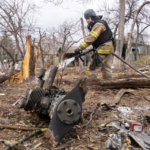
There is every need to bring this war – now being fought in its fifth year – to a close. Ukraine is losing people, territory and infrastructure, notwithstanding its ingenuity on the battlefield. Meanwhile, Russia’s critical infrastructure and installations are being systematically attacked. However, Russia is capable of a long, exhausting war. In the absence of concerted political and diplomatic will, this destructive military path will only continue.
But in the context of unprecedented rearmament by Nato and EU states, there is a real risk that today’s policy decisions will not deter future aggression, but rather serve to escalate the conflict and result in the kind of pan-European war we thought had been consigned to history.
In the absence of concerted political and diplomatic will, this destructive military path will only continue
There is, however, a third option beyond maintaining the conflict or escalation: a negotiated peace agreement that is acceptable to all countries involved. For this kind of deal to succeed, there first needs to be a complete transformation in relations between the US and Russia – the two most decisive parties in this conflict. The Alaska Summit hinted at what might be possible, if only each country continues to build bridges with resolve.
Where does Europe fit in? At present, it has no meaningful place at the table. The current generation of leaders have departed from the ideas and values of the EU’s founding fathers –Adenauer, de Gasperi, Monnet and Schuman – who articulated and fostered a united Europe founded on peace.
Monnet taught that to build Europe, was to build peace. That task now requires fresh thinking and a willingness to unsettle the status quo. Fortunately, there are signs of movement following the efforts of the Trump administration – despite its wider foreign policy missteps—to help create conditions for dialogue with Russia.
The US, Europe, Ukraine and Russia now need to develop an enduring peace that promotes mutual flourishing. To do that, they should return to the principles espoused by Schuman and Marshall, which were developed in response to the devastation wrought by the Second World War. The success of these schemes is inspiring and remains instructive to this day.
The Schuman Plan established the European Coal and Steel Community, a framework that promoted reconciliation and unification between states that had previously been at war. The Marshall plan proposed to finance recovery across Europe, including the defeated aggressor– Germany. Each planted the seeds for economic recovery and co-operation, which until recent years had continued unabated.
One need only recall the atrocities committed by the Nazis to understand why both plans were viewed by many as, at best, utopian and, at worst, a profound betrayal. Yet the bold shift in relations they encouraged, underpinned by innovative ideas, created the conditions for a genuinely constructive path toward a peaceful, stable, and prosperous Europe—at least in those countries that participated.
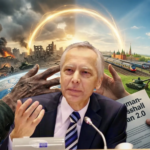
Europe must now recommit to the ideas of these post-war visionaries to produce a Schuman/Marshall Plan 2.0. The transformation in relations between the US and Russia will be a prerequisite to its success. Trump has set the stage for this strategic co-operation, and in doing so, builds on the history of dialogue and partnership between Washington and Moscow that defeated Nazi Germany and faciliated the non-violent demise of Communism in Eastern Europe. Once the relationship between Washington and Moscow has improved, the conditions will then be set for the return of Europe’s diplomatic voice.
The Schuman/Marshall Plan 2.0 has two core elements. First, the development of economic co-operation. A common market for critical resources – energy and its infrastructure, raw materials and rare minerals – should be developed. This common market will be open to all nations, but especially those in Europe and North America, with the potential for Central Asia to participate too. Second, the creation of a new shared security architecture. This will create a zone of mutually beneficial co-operation that stretches across the US, Europe, Russia and Central Asia – from Alaska to Kamchatka.
Just as after the Second World War, shared security and co-operation would render conflict impossible. It would remove the roots of the current war in Ukraine, while preventing future military confrontation.
This would then create space for a dignified peace settlement acceptable to Ukraine and Russia. It would necessarily involve a comprehensive package of conditions and compromises: the return of refugees and displaced persons; guarantees of dignity and fundamental rights for all; a transitional, time-limited administration of disputed territories under international oversight; respect for the transparently expressed will of local populations regarding democratic self-determination; the application of transitional justice to war crimes; the restoration of the rule of law; the lifting of all sanctions; targeted support for reconstruction and development.
For the Schuman/Marshal Plan 2.0 to work, there will need to be sustained efforts in reconciliation and dialogue – the kind that enabled Europe to recover after 1945. But with good faith, will and ingenuity, the Schuman/Marshall Plan 2.0 could kindle the recovery and renewal of a continent riven by the worst conflict it has seen in decades.
We must now strive for a dignified peace agreement that seeks not to humiliate nor contains the seeds of future military confrontation. Lasting peace in Europe is a demanding but rewarding objective, and only through creative, constructive and responsible efforts will we prevail over the forces of conflict, violence and war.