 English
  Slovenčina
 By Ján FIGEĽ, Former EU Commissioner & Dpt PM of Slovakia
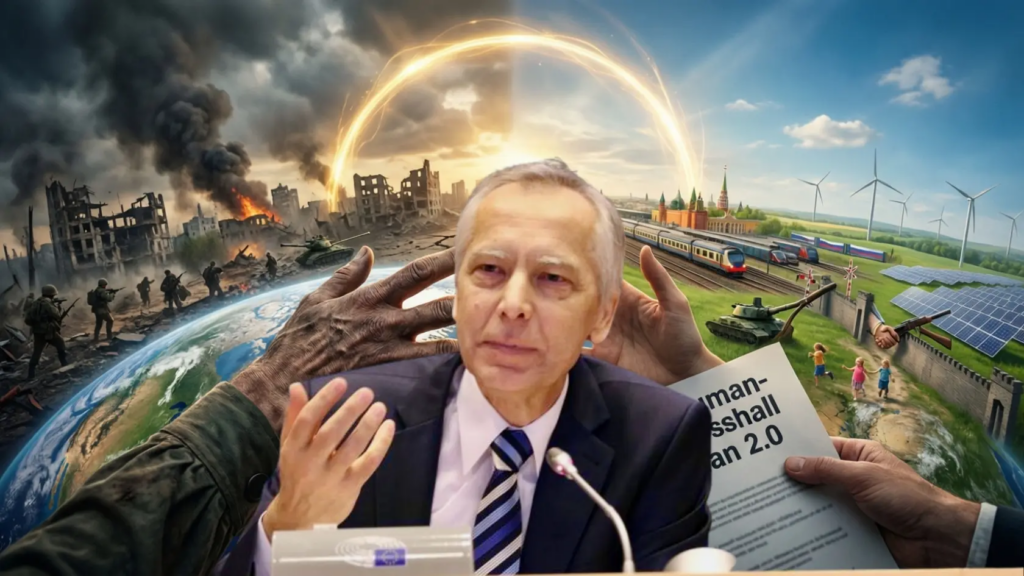
Despite growing unrest and tension in the world, we must not give up in our efforts for a more peaceful and humane century. In the current state of the ongoing hot and cold wars in Eastern Europe, there are essentially only three scenarios: bad, much worse and … a hopeful one.
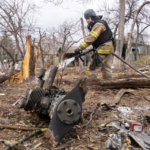
A) The continuation of the war is the most likely today. Ukraine is bleeding, losing people, territory and infrastructure for four years already. Without a reasonable political solution and constructive diplomatic efforts, only a destructive military path is advancing. Interventions against infrastructure and facilities in Russia are numerous, but Russia is capable of a long, exhausting war. Even with the support of the collective West so far, Ukraine does not have the strength to expel Russian troops, nor even to stop it.
B) A catastrophe through the escalation of war cannot be ruled out. Two world wars have emerged from Europe. The tragedies of the 20th century may be repeated. NATO has failed to implement a wise and effective policy: the prevention of war. The EU has gradually changed from the fruit of a peace project to a consumer of peace. The unprecedented armament promoted today in NATO and the EU may deter future aggression and strengthen defense industry, but it will not bring peace, nor create a prosperity.
C) A true peace agreement, acceptable to Russia and Ukraine, supported by the USA and Europe, can therefore arise on the basis of a turnaround in relations between the two decisive parties to the decade of confrontation: the USA and the Russian Federation. They are de facto parties of the current proxy war. This U-turn is possible, if President D. Trump’s determination to stop the war in Ukraine, confirmed at the Alaska Summit with President V. Putin, continues with a resolve.
Building Europe means building peace
An acceptable peace agreement as a package of conditions and solutions acceptable to warrying parties have not been found yet. Therefore, every constructive effort to reach an agreement between Russia and Ukraine should be appreciated. European powers (France, Germany, UK) have failed to secure peace in Ukraine in the past decade. Unfortunately, current EU leadership does not follow mentality, nor practice of R. Schuman, nor K. Adenauer – Founding Fathers of reconciled and united part of Europe after the WWII.
The path to peace is narrow and difficult. In the spirit of Jean Monnet, building Europe means building peace. However, such a vision and process require a new and strong foundation. Change of strategic paradigm raises difficult questions. First, is it possible to turn the political, security and economic relations between the superpowers by 180 degrees? Second, is it possible to make war in Eastern Europe materially impossible and peace stable and lasting? Third, is it possible to achieve this in a short time? It is certainly easier to answer such fundamental questions after the fighting is ended and the peace agreement is signed.
I am convinced that, despite everything that happens today, the current geopolitical situation allows us to answer these three questions by YES. Surprising, perhaps even provocative solution is realistic. Realism is based on the history of the Euro-Atlantic area after World War II and on ongoing international consultations. We may have many reservations about the actions of the D. Trump and his Administration towards Europe or Venezuela. But his determination to stop the war in Ukraine as soon as possible is evident. It can be built on, and it can become decisive. Realism of the proposed vision is already evidenced by some points from the agreement, which is being gradually discussed between the USA, RF, Ukraine and the EU (E3).
A peace scenario in the spirit of R. Schuman and G. Marshall
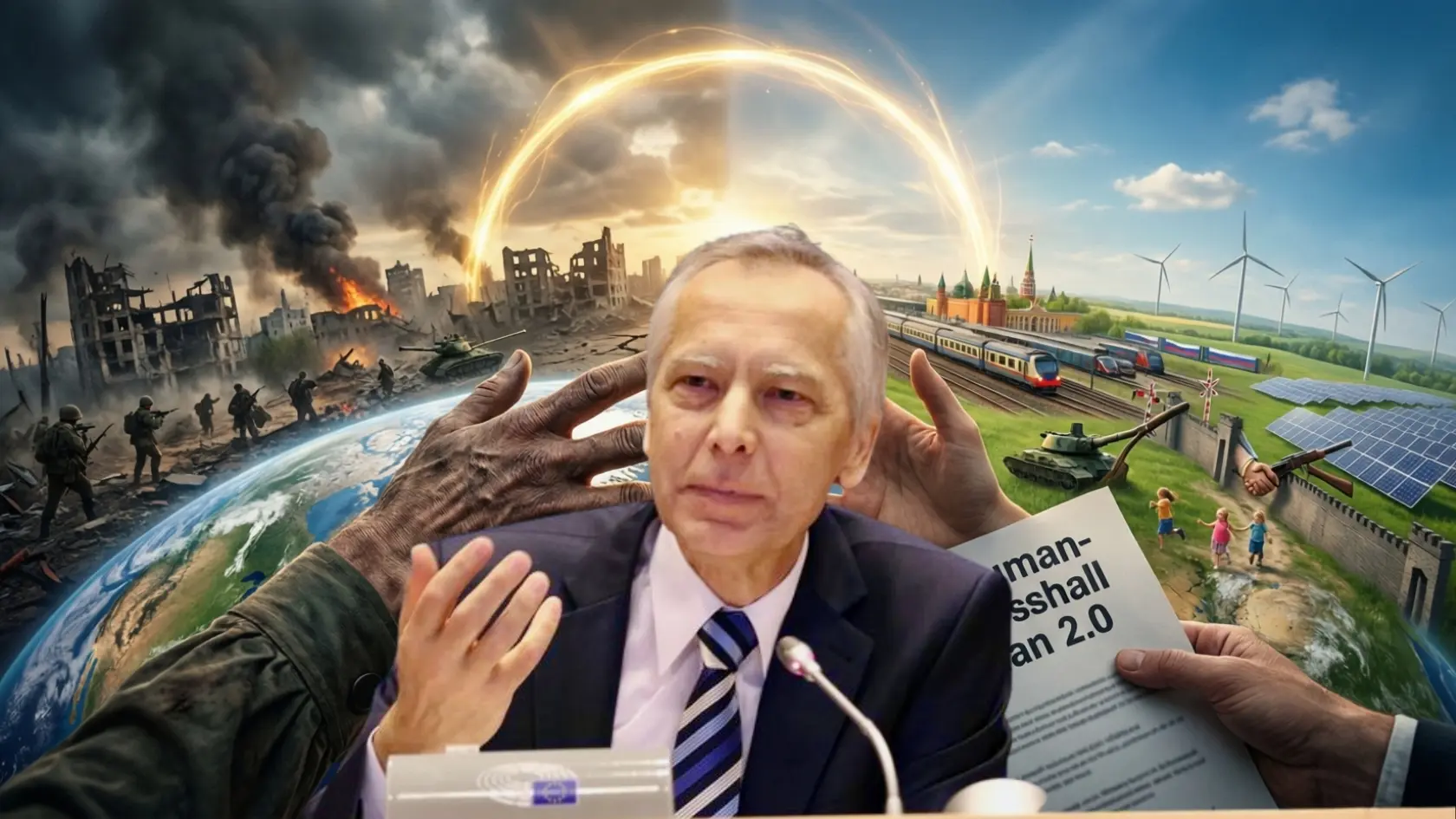
I am convinced that peace in Eastern Europe can be achieved through an updated combination of the principles of the Schuman and Marshall plans. Their authentic historical results are consistently inspiring, proven and valid even today. The original Schuman plan was about preventing further war and devastation in Europe. For the participating countries, this project has become a reality and has been successfully operating for more than 75 years.
Today, we need an analogous action. I am deeply convinced that the Schuman and Marshall Plan 2.0 is possible. Transforming confrontation between two superpowers into their long-term and strategic cooperation is in the interests of both countries and their successful development. Leaders come and go, but nations remain. However, leaders can leave a positive legacy that will raise the lives of the peoples concerned to a higher level. The joint effort of East and West, Moscow and Washington, was the prerequisite and basis for the victory over Nazism and fascism in Europe. Likewise, the peaceful demise of communism was achieved non-violently, thanks to dialogue, understanding and cooperation between the West and the East, between Washington and Moscow.
Foundation of this peace initiative should be an agreement between the two Euro-Atlantic powers: the USA and Russia. Economic and trade cooperation in the form of a common market must cover the resources and commodities necessary for waging war: energy and its infrastructure, and natural raw materials – rare minerals. Likewise, it is important to open up information technologies, artificial intelligence and intellectual property to the common market. An agreement on a common market for the aforementioned resources and commodities between two strong protagonists must be open to all free countries, especially those of Europe, North America and Central Asia. This must logically be accompanied by an agreement between the participating countries on shared security. Mutually beneficial cooperation could gradually lead to the creation of a great West-East Community from Anchorage on Alaska, to Vladivostok on Kamchatka, across Europe and Central Asia. War in such Community would become impossible and unthinkable, as it was in the case of a unified Western Europe after 1950. Such a vast zone of shared security, cooperation and prosperity in the Northern Hemisphere would constitute an unprecedented force for peace and stability throughout the world. The first reactions to this vision are encouraging.
Thanks to the proposal of R. Schuman and the approval of K. Adenauer, France and Germany began peaceful cooperation after 1950 in coal and steel. Schuman’s plan for a united Europe was an unprecedented political innovation. For many Europeans, reconciliation and unification with the former hostile power and aggressor was a utopia, for others a provocation, and some in France considered it a betrayal. However, the unthinkable partnership and friendship gradually became reality. This great and creative innovation, supported by the firm commitment of national governments and parliaments, proved to be a real and constructive path to a peaceful, stable and prosperous Europe! Unfortunately, this peacebuilding process in recent decades has not reached the entire continent, from the Atlantic to the Urals. Now we pay a very high price for the many failures in the necessary efforts.
A way out of the war is possible. However, true statesmanship, political courage, goodwill and programmatic perseverance in shaping this new path are crucial. The roots of conflict must be removed to make peace sustainable. And prevention of conflicts lies in the sharing of security and strategic resources. The roots of our common Judeo-Christian civilization invite us to mutual respect, to beneficial cooperation and to live in peace and unity.
A dignified peace agreement
Such a Great Deal will serve not only to create a new, West-East Community in the Northern Hemisphere, but will also create the basis for a dignified peace agreement beneficial and acceptable to the USA, the Russian Federation, Ukraine and the countries of Europe. The package of conditions and compromises must include the return of refugees and displaced populations, respect for the dignity and fundamental rights of citizens, including ethnic minorities, a transitional, time-limited administration of the disputed territories with international support (UN, OSCE), respect for the transparently expressed will of the inhabitants of the affected territories for democratic self-determination, the application of transitional justice and the restoration of the rule of law, and the termination of all sanctions. Marshall Plan 2.0 will define conditions and offer effective help for economic stability, growth and prosperity. Special support must be given to targeted, dynamic reconstruction of destroyed territories and infrastructure. Such process also requires constructive efforts for reconciliation, dialogue, confidence-building and will deliver new relations among nations and states.
This basis for a dignified peace agreement can be an acceptable and face-saving way out for all, without gray, disputed areas and without postponed or hidden confrontation. Lasting peace in Europe is a demanding, but noble and rewarding objective. Innovation does not come from new ideas, but from the ability to see old ideas in a new light. I am convinced that creative, constructive and responsible efforts can triumph over the forces of conflict, violence and war in the near future.
https://europeantimes.news/2026/01/3-scenarios-and-hope-for-europe