 English
  Slovenčina
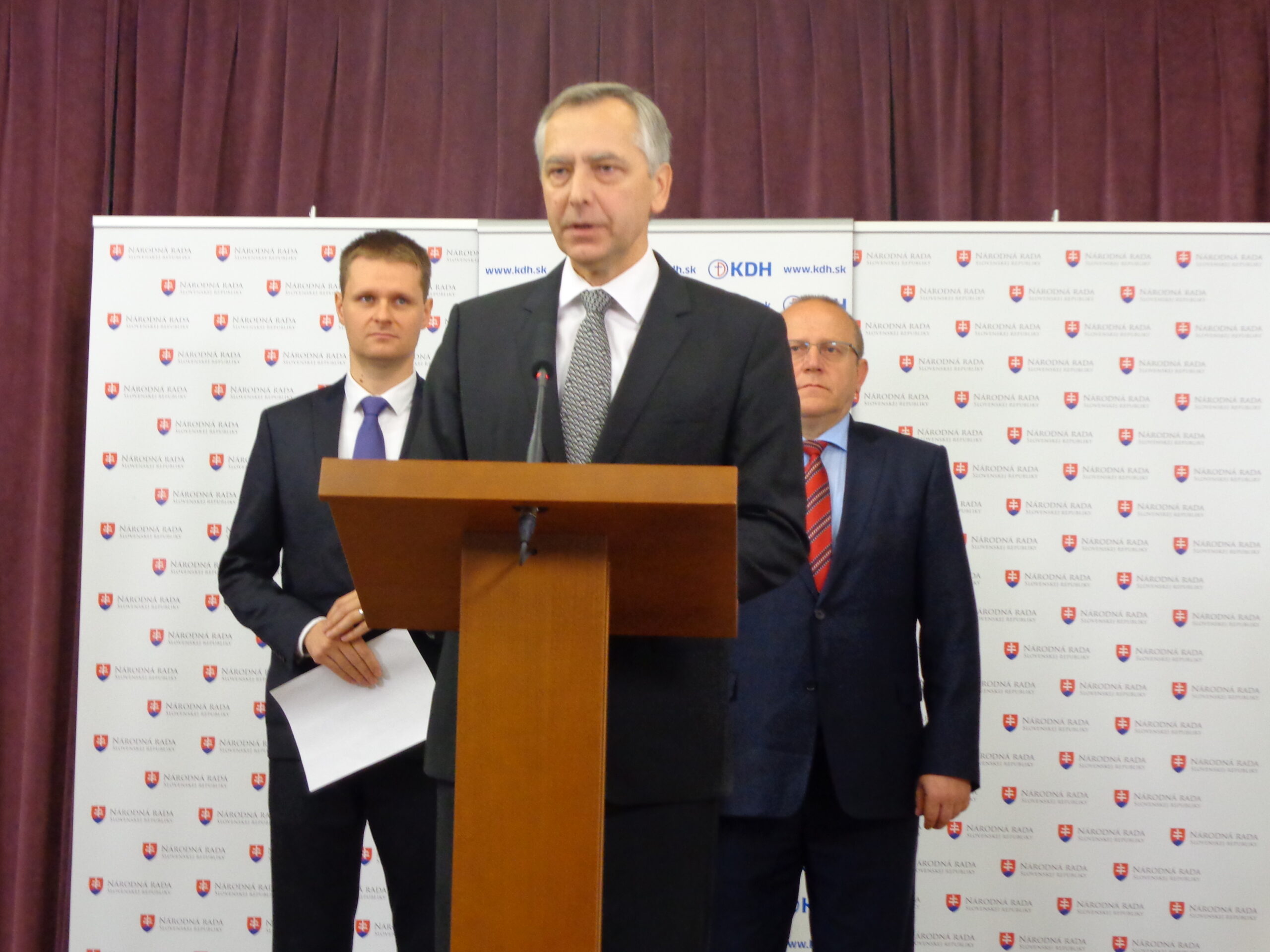
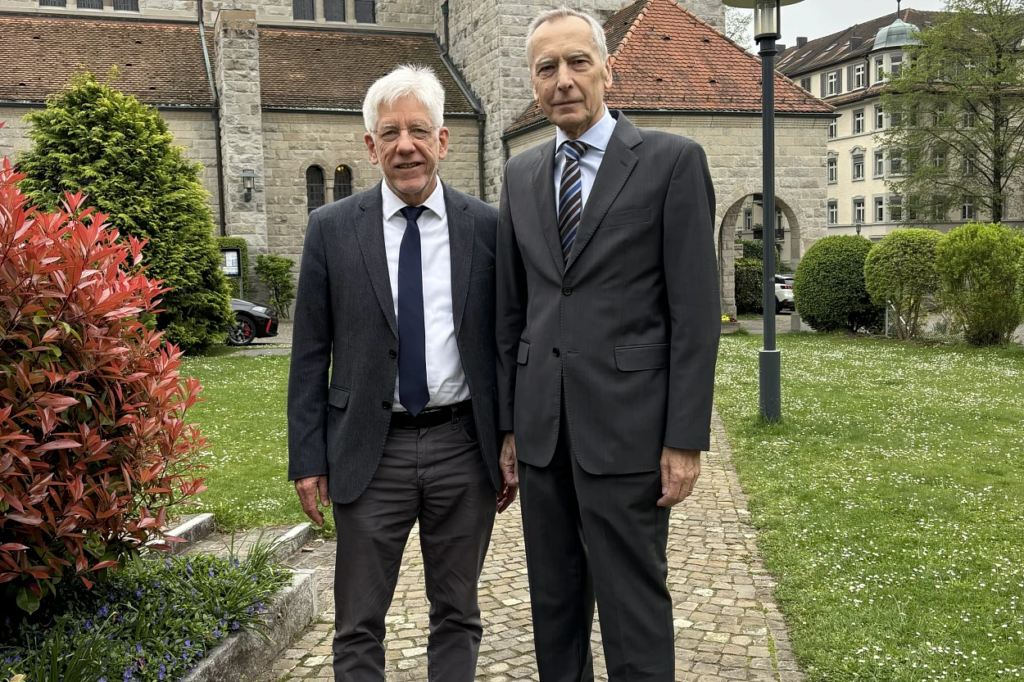
 Freedom of religion or belief is important for all people, believers and non-believers, according to Ján Figeľ. The former European Commission Special Envoy for the Promotion of Freedom of Religion outside the European Union stressed the strong nexus between religious liberty and human dignity in a keynote speech to the annual conference of Christian Solidarity International (CSI) in April. If religious liberty is not respected, neither will the other human rights be respected, he argued.
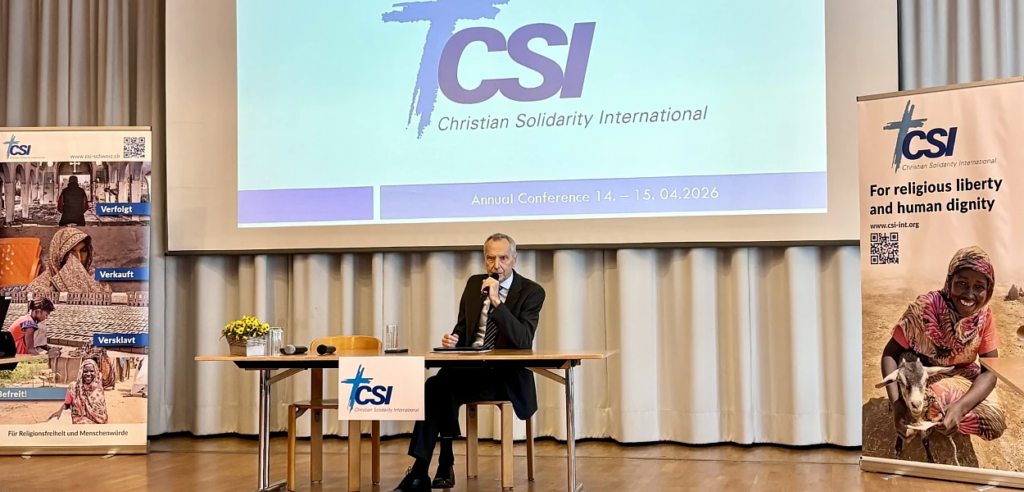
SPEECH DELIVERED BY JÁN FIGEL’ ON APRIL 15, 2026
Good morning, everybody. Laudetur Jesus Christus.
I’m really honored and glad to be here. The invitation from [CSI President] John Eibner came rather quickly, after we met together on Capitol Hill in Washington DC and acted together for the sake of religious freedom and respect and autonomy in Armenia.
To add to my introduction, I am a husband and father of four. And my name, Ján Figeľ, belonged before me to my uncle, Ján, who disappeared under the Stalinist regime in Czechoslovakia, under President Gottwald. And since that time, we don’t know where he ended, where he was buried, whether in the region or, some people said, in Prague in prison, or in Siberia in the Gulag.
So, whenever I’m introduced, I always try to reconnect with my father and his brother and the generations who paid the highest price for our freedom. Freedom is never for free. It doesn’t come from the climate. Freedom is a great value based on sacrifice. The future is born through sacrifice. If we lose the understanding of sacrifice and meaning and devotion, we lose the future.
And the difference between those who have faith and those who have no faith is that people of faith expect the most important, the most decisive, the most beautiful in the future. Not in memory, not in the photo album of your wedding or childhood or young age. This is something for the future, for eternity, which always starts now, not tomorrow.
And wise people know that it started already in the past, because we are not building on a green meadow or from point zero. We have a legacy, a very important legacy. Pros and cons, lessons to remember, to learn from.
[Pointing to a CSI banner, which says, “For religious liberty and human dignity.”] I didn’t know that there would be such a poster here speaking about religious liberty and human dignity. Because there is a very deep and strong nexus between the two. And therefore, one can say that religious freedom is a litmus test of all human rights.
A significant problem of our times and our generation is that words lose their meaning, or that we don’t seek the meaning of words and sentences and messages. As John [Eibner] said earlier, we agree that religion creates culture, and culture creates civilization. And now our civilization is in a very deep crisis. So, let’s look back to the roots. Why? What is the real problem? Part of the problem around so-called FoRB, freedom of religion or belief, is that we don’t correctly understand its meaning.
International or even national constitutional law recognizes religious freedom as freedom of thought, conscience and religion—the three. Each human person, you and I, is triune. Our being connects human rationality, morality and spirituality. This is not either/or. These three dimensions are intrinsic, integral. We have our rationality, our morality and our spirituality or religiosity. Only in three dimensions is “FoRB internal” filled in.
And if this FoRB internal, the most inner freedom of a human person, is not respected, because of a totalitarian regime or autocracy or fundamentalism, then the subsequent freedoms—surely one hundred plus percent—will not be respected: freedom of expression, freedom of opinion, freedom of media, freedom of association, freedom of assembly, freedom of property.
This is a lesson of communism. This is a lesson of Nazism, fascism, and of any ideology. Because ideology is the abandonment or refusal of reality, of truth, for the sake of a vision, an illusion, the “new man,” “new humanity,” “new society,” which usually is a hell on earth, not anything “new.”
Therefore, it is very important to understand the content of religious freedom. And it means that FoRB is important for all people, whether they say they are believers or non-believers. Everybody believes in something or somebody. So religious freedom is important for people from A to Z, from atheists to Zoroastrians. Not just communities and religious minorities, but for all. And with that meaning and understanding, we would be more successful in defending freedom for everybody and also for communities, because religion brings together those who are spiritually like-minded and creates a community, for two or three or millions or even billions.
Please remember this, because without this, we lose all human rights. And if fundamental human rights are not defended, then we lose or damage the dignity of humans, of human beings. Freedom of religion or belief is important because it covers the private and public life of everybody. It is important because it is the expression of individual and collective freedom. No other freedom has such complex expression, understanding, and content.
Therefore, FoRB, or religious liberty, is a litmus test of all fundamental human rights. If it is not respected, others will not be. If it is respected, we have a chance with the others.
The secular state is a blessing for religious freedom, not a problem. The problem is secularism, which actually replaces a secular state based on plurality with an ideology—atheism, Marxism, whatever-ism—instead of plurality and true freedom for all. This is also an issue of our times, when we see democratic countries imposing decisions which lack either legality or legitimacy or proportionality. These three features are what is required from states that wish to regulate religious freedom for the sake of public order, public health or security.
I was involved in a court case in my country, Slovakia, which I love. Repeatedly, during COVID, the state decided to close churches and ban worship, while trams and buses were full of people. Shops as well were full of people, but the church community worships were empty. Six persons maximum were allowed, whether they were in a cathedral or a small chapel. It was absurd. So, I had to go to the European Court of Human Rights in Strasbourg with my submission. And it was accepted and registered.
Three independent third parties were admitted by the Court, and all three argued on my side. After four years of deliberations, which were costly, demanding, professional, and a lot of work, the Court decided in a very alibistic way that the case was “inadmissible.” For four years, we paid all for the judges to only say: “Four years ago, there was a mistake done.”
There was no mistake. This was either alibism or activism, no decision on the merit. You can choose whichever you think. But justice is lacking more and more, and religious freedom is suffering in democratic countries, whether we speak about Finland or Slovakia or Japan or other countries. It’s a pity, because Western civilization was based on religious freedom after the so-called religious wars, and when we lose these roots, we will lose much more.
Those who do not understand religion, and especially the abuse of religion, cannot understand what is going on in the world today. And if we don’t understand what is going on, how can we help? How can we heal a patient?
To begin, we have to understand religious freedom, and then to defend it. As I said, FoRB is a very complex litmus test of all human rights. Its dimensions are those of our living in private and public domains. It refers to teaching, worship, practice, and observance. If there are limitations, these must be lawful, legitimate, and proportional.
What is also missing today in the world is religious literacy. The world is more and more diverse, and in order to live together, not only to exist together, we need to know the others. We need to understand what makes us different. This is not a call for a kind of artificial behavior or syncretism. The ideal creed of humanity is “united in diversity.”
And that’s deeply important even for religious expression, because everybody is different. Nobody is a copy of anybody, unless we start cloning. But we are one, one humanity. Equal in dignity, different in identity. Both are important. My identity is unique, irreplaceable, unrepeatable. Whether we look at the eight billion people today, or billions of people who came before, or the billions coming in the 21st century, I am unique, original, authentic. And it matters. My son is different from me. That’s okay.
But we are all equal in dignity. This understanding is the special contribution of Christianity. If anything matters, it’s dignity. We believe it is the image of God, Imago Dei. When the last Catholic Council, Vatican II, adopted a special document on religious freedom, a document especially inspired by American bishops, its title was Dignitatis Humanae. So, there is, and not only for this reason, a very deep and strong nexus between the two: religious freedom and the dignity of human person.
Equal dignity is a moral and ethical principle, but it should translate into action or legal status, which means equal citizenship. And this is the problem in many, many countries today. At conferences we hear about equal dignity, but in reality, there are second-class and third-class people in many countries, in most populated countries, in the superpower called China, etc. This lack of recognition of the dignity of all and dignity for all is a problem of our times. We should do much more to promote this understanding, because through dignity we will get back to the understanding of human brotherhood.
This is not only religious language. Human dignity is mentioned, referred to in more than 160 constitutions worldwide. Can you imagine? It’s a global consensus. One hundred and sixty, including India from 1947, in the preamble of the Indian constitution. But the reality is that, according to the 2019 Report by the Bishop of Truro for the UK Foreign and Commonwealth Office (FCO), 250 million Christians are persecuted today. And that is only counting Christians—many other communities are persecuted as well. This is the most scandalous violation of human rights. This is the language of an FCO report, from London. Open Doors spoke last year about 350 million Christians being persecuted. More people are affected by persecution, or are not free in their conscience, than are affected by climate change. The United Nations cares a lot about climate change, but very little about religious persecution. Nine out of ten genocides in history have been based on religious affiliation and religious identity. So, if we cared about religious freedom or eliminating this dimension of the crime of crimes, genocide, we would really make the 21st century more humane. Because genocides are still present.
The levels of religious persecution are 1) intolerance or social violence, 2) legal discrimination, 3) persecution, and the most inhumane is 4) genocide. It’s not true that we stick to our commitments. In 1948 the international community passed the Genocide Prevention Convention, and said, “never again.” The reality is again, and again, and again. We fail, we as humanity.
I mention this because we need to nurture a culture of human dignity, of all and for all. When I was Special Envoy for Religious Freedom outside the European Union, with like-minded academic experts we adopted such a declaration, the Punta del Este Declaration on Human Dignity for Everyone Everywhere. It explains in ten points why dignity is important. You can find it at the website www.dignityforeveryone.org, and even add your signature there. There are hundreds of signatories—leaders from academia, media, politics, religion.
The whole concept of human rights starts with the UDHR, the Universal Declaration of Human Rights, adopted in Paris on December 10, 1948. Dignity is not only in the preamble, but is mentioned five times in this founding document of the United Nations.
The same is true for the United Nations Charter, and for the ICCPR, the International Convention on Civic and Political Rights. So, it should be in our DNA, in our international and national laws. But we tend to undermine the dignity of the unborn, the dignity of the elderly, the dignity of minorities, etc. And then we see evil. Evil is growing everywhere, including wars.
I don’t want to speak too much, so I will conclude with the return of war to Europe, and not only to Europe. Evil is successful because it has very cheap and omnipresent, well-distributed allies, including Switzerland, Slovakia, the United States. I say this not to blame or shame.
The three siblings of evil, or allies of evil, are very efficient. The first one is indifference. We don’t care because it’s far away, it’s not us, it’s not me, what can I do? Indifference is probably the most striking problem of our times.
The second is ignorance. We don’t learn, we don’t know, we don’t understand, because it’s complicated, complex, and we don’t even have the effort to understand.
And the third sibling of evil is fear, human fear. Fear to do something, to say something, to stand up on behalf of the voiceless or the defenseless because it might cause us problems.
For our own sake, we have to do something constructive, which first means being active and engaged. This leads me to a tribute to this organization of like-minded people who care instead of sitting at home and doing hobbies or commenting and lamenting what’s going on in the world today. Second is education. Education is a lifelong effort. Education is not preparation for life. No, education is life itself. We have to learn until the very end, which is not the end, but maturation for eternity. And the third one is very simple but indispensable: courage. N´a pas peur! Don’t be afraid! You are not alone. We are not alone.
The war in Europe is a consequence of all these deficits, including or especially the loss of togetherness. And we exist together. Western civilization speaks about itself. But, for there to be Western, there must be Eastern. “Cain, where is your brother?” The spirit of brotherhood was proclaimed in the French Revolution: Liberté, égalité, fraternité.
But usually, this last one is missing. We love freedom. We love equality. But who cares about fraternity? We want rights. Who speaks about duties? There is often a one-sided coin.
God doesn’t take vacation. He cares. He was working. He is working. And we are in the image of our Father. So, we should care. We have duties. I have duties as a husband, as a father, as a citizen—not only rights. But in school, in media, in the United Nations we hear: Rights, rights, rights: New rights, more rights, all rights, secondary rights. There is a consequence. Because if the balance is not protected, then we go into crisis, decline.
The war in Europe is a tragedy. But it can even be a catastrophe. Most of you are Europeans or connected with Europe. Europe received a lot in history. It possessed a lot. But it also brought global wars. Two world wars came out of Europe.
There are basically three scenarios for the immediate future of Europe, in relation to the war in the East. Our choice now is not between good and bad, but between bad and worse. The bad scenario means that the killing will go on until the very end. Because each war will end at some point. One side will collapse; something will happen. And day and night, or night and day, killing is going on. Every night, every day.
There was a break now because of Easter. And it’s been going for over four years now. President Trump promised to finish this war in 24 hours, but already one year was not enough. Because real estate negotiators cannot make peace. All these meetings in Abu Dhabi, in Islamabad, in Istanbul, or Geneva, or Florida, didn’t bring a successful peace proposal. So, nobody believes in this anymore. It’s a European war. Europe should pay— Americans will sell weapons—if they still have any after starting another war. It’s a nightmare.
But the worst scenario is that there will be a provocation. There are enough crazy people around, and enough armaments, including nuclear. We could have the third world war. Nobody can exclude it. The unimaginable may become a reality.
But I didn’t come here to spread fear. I am here to spread commitment and hope. There is a hope for peace in the East, in Europe, which means also hope for the Middle East, or in the global situation, because it is interrelated—if we apply the unique Christian experience from the post-Second World War era.
After World War II, the French statesman Robert Schuman—declared the venerable Robert Schuman by Pope Francis in 2021—proposed a plan which was adopted by France’s main enemy, Germany, and then by some others, to unite production of coal and steel—material commodities indispensable for waging war. But the objective was not coal, steel, and economics, but peace in Europe. And for 75 years it has held true for the participating countries. It’s a unique model, unprecedented, very attractive, bringing peace, stability, and prosperity. But we failed to, or gave up trying, to get the Western Balkans and then Eastern Europe into the one house.
The second great lesson was from General George Marshall, from the United States, also a Christian. He proposed a plan of economic recovery that involved inviting not only allies or winners, but also the former aggressor, Germany. Because of the Marshall Plan, many people said that Germany was a winner at the end. Western Germany was better off than Eastern Germany. And that was true. But the point was: not to take revenge. It was to make a nation who was an enemy into a partner, even a friend, even an ally. A brother again.
This is a truly Christian attitude—to forgive, to return to equality at one table. If these lessons and principles are applied in Eastern Europe now, I would like to say that this year, we can have peace in Europe, even lasting peace in Europe. I am working on this. I write a lot about it, and travel as well.
We need to combine the two important principles, ora et labora: to pray and to do what we can. A bit, not much—bring five pieces of bread and two fish, and thousands and thousands will get fed. But give what you have. Don’t ask God to do that which is our role to do. We are here with our talents, with our time, with our friends. And we are invited to work in harmony with Him.
So, I would conclude maybe with my own recommendation, which I think is very useful and pragmatic for your mission, and for our personal responsibilities. Beside ora et labora, we need to combine hardworking, team working, and networking.
If I do what I could and should, then, I at least did my portion. The hypocrites usually know what others should do. But they don’t do. So, it starts with hardworking.
Team working means that 11 well-trained, well-focused, and cooperative players are better than one Maradona. If you are a team, that means synergy, additional power, and added value. Some people say, “I like teamwork. I am the team, and you work.” (Laughter) So hardworking, team working, and networking. Today we are really one world. We can switch on media and communicate with people in Japan or Australia immediately, hic et nunc, here and now. Networking with like-minded people can make a difference.
And I am convinced the 21st century can and should be more humane and more peaceful. It is possible. It is our personal and generational responsibility. My uncle paid the highest price. It’s time for me to repay my peace and freedom, to pay my part. But a price which is rewarding. It makes sense. And together, we can really achieve improvement in freedom of religion for all, dignity of all, and peace for all.
Thank you very much. God bless you.
Ján Figeľ, 66, is a Slovak politician. From 2016 to 2019, Figeľ was European Commission Special Envoy for the Promotion of Freedom of Religion outside the European Union.
https://www.csi-int.org/news/jan-figel-religious-freedom-is-a-litmus-test-of-all-human-rights/
Related posts:
 Persecution of Religious Minorities in the Middle East urges EU to act
 Figel’: “Action for Religious Freedom is a Moral Obligation”
 “Action for Religious Freedom is a Moral Obligation”
 COVID-19 Crisis, Human Dignity and Freedom of Feligion or Belief
 COVID-19 Crisis, Human Dignity and Freedom of Religion or Belief
The Strong and Deep Nexus Between Human Dignity and Religious Freedom
COVID-19 Crisis, Human Dignity and Freedom of Religion or Belief
The Strong and Deep Nexus Between Human Dignity and Religious Freedom